Posts

ONCE UPON A TIME: The Fairy Tale Influences in German Expressionism & the Auteur of Tim Burton

Image
  This month, Year 1 DP Film scholars will be venturing down the rabbit hole that is German Expressionism in film making as you explore  The Cabinet of Dr. Caligari,  and, just in time for the holiday season, Tim Burton's  The Nightmare Before Christmas.    Links to these films in the drive are available on our website, but they may also be found on our Plex server.   The following article is an exceptional study of how German Expressionism has gone one to influence, and even define the very style and voice of filmmakers like Tim Burton. There is also a link to a great youtube video about the influences of German Expressionism on modern filmmakers like Time Burton. Please read the blog entirely--you may even wish to take some notes as future filmmakers! Not only is this a study of style, but it is, perhaps, more importantly, a study in context. What inspired this strange and wonderfully unique and distinctive style of filmmaking? Why is it so influent...

DOWN THE STEPS: An "Untouchable" Russian Montage Sequence that Revolutionized Film

Image
  In order to fully appreciate Brian De Palma's American crime drama,  The Untouchables,  every serious student of film must breakdown the very bloody, very pivotal "Union Station" scene shot by shot, noting every shot size, length, lens, and camera movement to explore how POV adds both depth and tension to an already by definition "intense" scene... One of the first things every film student notices about this scene is that it pays a very obvious homage to the "Odessa Steps" scene from Russian filmmaking legend Sergei Eisenstein's  Battleship Potemkin.   Although this may present as an example of "indirect intertextuality," make no mistake: De Palma is most certainly purposeful in his reference here.  Even the political and moral themes from  Battleship Potemkin  - the strain between the "bourgeoisie and the proletariat, innocence and oppression" are likewise factored into the narrative of  The Untouchables.   Eisenstein's ...

YEAR 2: MISE EN SCENE

Image
  There's no denying the importance of mise en scéne in filmmaking. Truly, it elevates film from just a record of movements and dialogue set to a sweeping score to an art form with depth, greater meaning, and purpose. In a translation from French to English, Mise en scéne means (quite literally): In short, it means to set the stage! This was originally coined in reference to theater. When speaking of film, the scéne or stage refers to everything in front of the camera, including set design, lighting, and actors. It may also be used in reference to the overall effect of how it all comes together for the viewer. As you are designing your own collaborative films, and as you are viewing your films of study this month, please complete the following for this blog discussion and exploration:  1. Read this article, including clicking the links within for the informational videos on mise en scéne:   https://www.lightsfilmschool.com/blog/mise-en-scene-in-film-afk  2. Choose on...

SOULS ON A ROAD: A Japanese Landmark in Early Filmmaking

Image
  Hailed as "the first landmark film in Japanese history" by film critic Mark Cousins,  Souls on the Road  is a film to which many students and scholars of modern filmmaking give a hard pass.  Some criticize the film as offering a patchy narrative and overly melodramatic character portrayals.  It has also been criticized as being "messy" by modern standards, in terms of directing, lighting, camera angles, and in its unconventional, non-linear storytelling. However, all of these criticisms can also be viewed as groundbreaking in these very areas. Once again, scholars, Context reigns as King!  It is imperative to note that at the time this film was made in Japan, live musicians played traditional instruments to one side of the screen, while a narrator or troupe of narrators called "Benshi" elaboratively explained ("setsumei") the action of the film and its dialogue during the screening.  When intertitles arrived in Japan, Benshi would often incorpo...

NON-LINEAR NARRATIVES & SLIDING DOOR PHILOSOPHIES: Breaking Rules and Making Your Mark (Year 2)

Image
You need to know the rules of writing.  That way, when you break them, you'll know why. A non-linear narrative in storytelling can be key to helping your story stand out.  So...what exactly IS a non-linear narrative?  It is a technique where events are portrayed out of chronological or traditional story order; the pattern of events jumps around.  It is also called the disjointed or disrupted narrative.  Click here to watch a complete definition of the non-linear narrative and how it is used.   Why do writers and filmmakers use it?  Sometimes, it is used to fill in character development in a creative and unique way.  Other times, it is used to hook in the audience--to shake things up a bit and get your story noticed.  Stories that are told in reverse or divergent points of view or paths juxtaposed against each other (like in Sliding Doors)  get noticed because they are different; they put the viewer to work and get them involved in ...

THROUGH THE LENS: A Comparative Look at Joe Wright's A Darkest Hour & Steven Spielberg's Saving Private Ryan

Image
 This week, as we are working on finalizing our Comparative Studies of film, I thought it might be a worthwhile exercise to look at two very accomplished, perfectionistic directors who LOVE looking at the world and reinterpreting it through the lens in creative, beautiful ways.  In the spotlight of our Blog for Year 1 this month are two sensational films:  Saving Private Ryan  and The Darkest Hour , directed by American Master Steven Spielberg and British Visionary Joe Wright.  Let's first take a look at both directors stylistically... Joe Wright:   In an interview with Hollywood Reporter,  Joe Wright confessed, "I'm not keen on method actors because I'm a bit of a method director in the sense that I have to feel their emotions, and I have to identify very, very closely with the character and see the world through the same lens as they see the world.  So really, those characters are always an extension of myself."  Wright went on to explain t...

A WHOLE NEW WORLD: An Exploration of Foreign Films and Cultural Contexts (Year 1 Scholars/Instructors Only)

Image
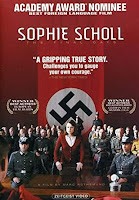
  "Foreign films teach you a new language, but it's not the language you think.  It's the language of cinema" - Vera Blasi, Academy Member. One of the great rewards of watching foreign films is the infinite ways it can open up the world for you as a viewer.  You identify with a character from another time and place.  You share their thoughts and feelings--their hopes and fears.  A sense of intimacy and humanity is created through the experience and we go from an "Us vs. Them" mentality to a "We are Them, They are Us" way of thinking. This month, there are five films made by foreign directors on our screening schedule: Sophie Scholl: The Final Days  (German - trailer link: https://www.youtube.com/watch?v=x14U3R3-dFE ), The Pianist  (Polish - trailer link: https://www.youtube.com/watch?v=BFwGqLa_oAo ), Three Colors: Blue  (France/Czech Republic - trailer link:  https://www.youtube.com/watch?v=Zxz-FQvRxbY ), Life is Beautiful  (Italian - t...